Is 43 Inch TV Actually 43 Inch? Real Size and Protector Fit
You have a 43-inch TV, or one on its way, and your tape measure says the screen is a little short of what the box promised. So, is 43 inch TV actually 43 inch? Broadly yes: the number is a rounded, diagonal figure for the visible panel, and small differences are normal.
What matters for a screen protector is the real visible screen, and that takes about five minutes to confirm. Our guide on how to measure your TV for the right screen protector size walks through each step.
Quick answer: A 43-inch TV is named by the diagonal of its visible picture, measured corner to corner and excluding the bezel.
In this guide
- What “43 inch” actually measures
- Why your tape measure says something slightly different
- Three sizes that get confused
- How to measure your own screen in five minutes
- Confirm it against the spec sheet
- Does a few millimetres matter for a protector?
- Is there a 42-inch and a 43-inch TV, and does it matter?
- Frequently asked questions
- Related guides
- Your next step
That works out to roughly 95 cm wide and 53 cm tall (about 37.5 x 21 inches), and your own measurement may differ by a few millimetres either way. A 43-inch protector is meant for this size class; confirm the width and height against your model’s spec sheet before ordering.
What “43 inch” actually measures
The size on the box is a diagonal measurement of the visible screen, from one corner to the opposite corner, not including the frame. It is not the width, and it is not the size of the carton. This is the industry convention, which is why a 43-inch TV from any brand lands in a similar range.
The diagonal is also a marketing-friendly, rounded label. Panels are made in sizes that do not always land on a whole number, so a manufacturer picks the nearest familiar label. That is why you will see 42.5, 42.51 or 43.0 inches in different spec sheets for TVs sold as “43 inch”. None of that means anyone has misrepresented the TV.
Why your tape measure says something slightly different
Most of the gap comes from how people measure. Three things cause nearly all of it:
- Measuring the frame instead of the picture. The bezel, the plastic or metal edge, adds length. Measuring it makes the TV look bigger, not smaller.
- Starting at the wrong corner. Many panels have a thin black border inside the bezel where no picture is shown. Whether you include it changes the figure by a few millimetres.
- Sagging or bending the tape. A tape that curves across the screen reads long; a diagonal that is not corner to corner reads short.
Rounding is the other piece. A true panel diagonal of about 42.5 inches is often sold as 43. We would not worry about a difference of that order. We would start asking questions if the diagonal were more than an inch off. That usually means you are looking at a different model from the one you think you have.
Three sizes that get confused
Buyers mix up three different dimensions, and that is the cause of most wrong protector orders.
| Measurement | What it includes | Typical for a 43-inch TV | Use for protector? |
|---|---|---|---|
| Advertised size | Visible panel diagonal, rounded | 43 in (about 109.2 cm) | As a size class only |
| Visible screen width x height | Picture area, no bezel | About 95 x 53 cm | Yes, this decides the fit |
| Overall TV width x height | Panel plus bezel (without stand) | Varies by model, usually a few cm more | No |
Figures are approximate for a 16:9 panel and vary by brand and bezel design; confirm exact numbers on your model’s manufacturer spec sheet.
How to measure your own screen in five minutes
Switch the TV off so the edge of the glass is easy to see, and use a flexible tape or a rigid ruler. Then:
- Measure the visible width, from the left edge of the glass area to the right edge, along the middle of the screen.
- Measure the visible height, from the top edge of the glass area to the bottom, along the middle.
- Check the diagonal with the formula: diagonal = √(width² + height²). For 95 x 53 cm, this gives about 108.8 cm, within a few millimetres of the 109.2 cm diagonal of a 43-inch panel.
- Write all three down in centimetres and millimetres, and take each measurement twice.
If your width and height are within a few millimetres of the 95 x 53 cm range, you have a standard 43-inch panel.
Confirm it against the spec sheet
The model number is on a sticker at the back of the TV and often on the box. Search that exact number on the manufacturer’s website and open the specifications page. Look for “screen size” or “display”, and for dimensions listed as “without stand”.
Be careful: the dimensions listed are usually the whole TV including bezel, not the picture area. Subtract the bezel on both sides, or simply use your own measurement of the glass.
Specs differ between brands and even between model years, so we avoid quoting one universal tolerance. Trust the sheet for your model and your tape for the glass.
A worked example shows how to use the sheet. Imagine it lists the TV at 96.8 cm wide and 56.5 cm tall without stand. If the bezel on each side looks about 0.9 cm wide at the sides and 1.2 cm at the top and bottom, subtract twice each.
That gives 96.8 minus 1.8, or 95.0 cm, for the width, and 56.5 minus 2.4, or 54.1 cm, for the height. Compare that with your tape reading of the glass.
Also note whether the sheet gives the dimensions in millimetres or inches, and whether it names the panel as 16:9. If the figures show a different ratio or a curved panel, contact us with the model number before ordering.
Does a few millimetres matter for a protector?
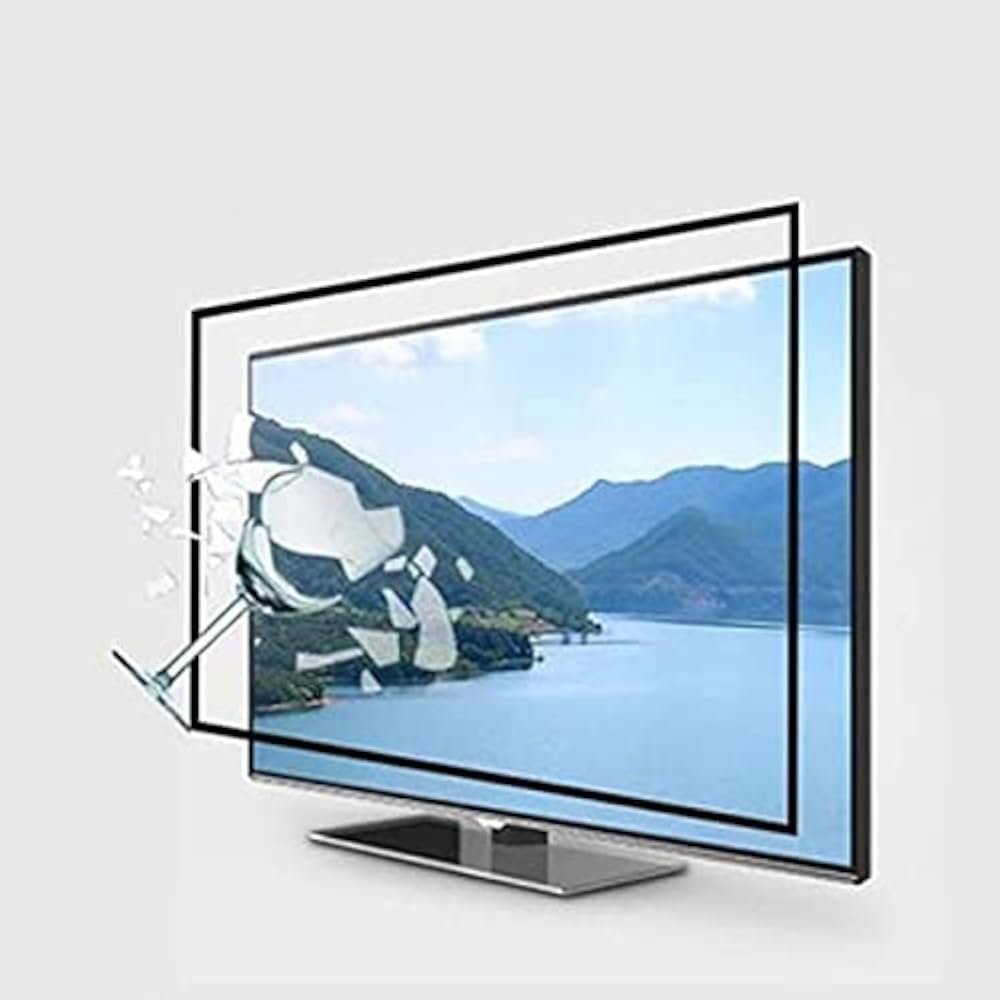
Match the protector to the visible panel, not to the label. A protector that is a touch undersized leaves a thin strip of bare screen at the edge. A few millimetres either way is workable.
Here is how to judge the margin with a worked example. Suppose your glass measures 94.6 cm wide and 53.1 cm tall, and the product page lists 95 x 53 cm.
The width is 4 mm under and the height is 1 mm over, so both fall within a few millimetres and the protector should sit properly on the panel. If your width came out at 93 cm, that is a full 2 cm short, and you should recheck the measurement or your model before ordering.
Before you apply it, clean the glass with a dry microfibre cloth, work in a room with little dust, and line up one top corner first. Because static cling holds by contact, lay it down slowly from that corner so no air or dust gets trapped underneath.
Once you have confirmed the dimensions on the 43-inch protector’s product page, compare them with your measured visible width and height before ordering. If a protector arrives in the wrong size, our 7-day returns policy covers wrong-size protectors: email us and we will sort it within 24 hours.
Is there a 42-inch and a 43-inch TV, and does it matter?
Yes, both labels exist, and the difference is usually about rounding and panel supply, not a real jump in picture size. A 42-inch and a 43-inch screen differ by about an inch on the diagonal, which is hard to see on a wall. Treat them as the same size class when buying a protector, then confirm with your tape.
Here is a worked example. Say a spec sheet lists a 42.5-inch panel diagonal. Multiply by 2.54 and you get about 108 cm. A 43.0-inch listing converts to about 109.2 cm, so the two differ by roughly 1.2 cm along the diagonal.
Spread across a 16:9 shape, that is only about 1 cm of width and 0.6 cm of height. Both numbers sit inside the few millimetres to one centimetre of play you already see between brands.
To settle it for your own set, check three things. Look at the model number on the back sticker and the “screen size” line on the manufacturer’s page, then compare your own measured width and height of the glass. If your measurements match the 95 x 53 cm range, the 43-inch size class is the right one regardless of which label your TV carries.
Frequently asked questions
Does a protector change the picture?
A crystal clear protector should look almost invisible, while an anti-glare one softens reflections and adds a matte finish. Our guide on anti-glare versus crystal clear helps you choose for your room’s lighting.
I rent. Is a protector still a good idea?
Yes, as long as you check first. Our protector uses static cling with no adhesive, so it is held by contact with the glass and does not glue to the screen. Before ordering, confirm the size against your measured visible width and height, and check that you are comfortable with how it comes off when you move out.
What if my TV is curved or an unusual shape?
Send us the model number and your width and height before you order. Standard flat 16:9 panels are the easy case, and anything else is worth checking first.
Related guides
- Anti-Glare vs Crystal Clear TV Screen Protectors
Your next step
Measure the visible width and height, compare them with the listed dimensions of our 43-inch TV screen protector at Screen Guardian, then order. The 43 Inch TV Screen Protector is priced at ₹1,899 with free shipping.