
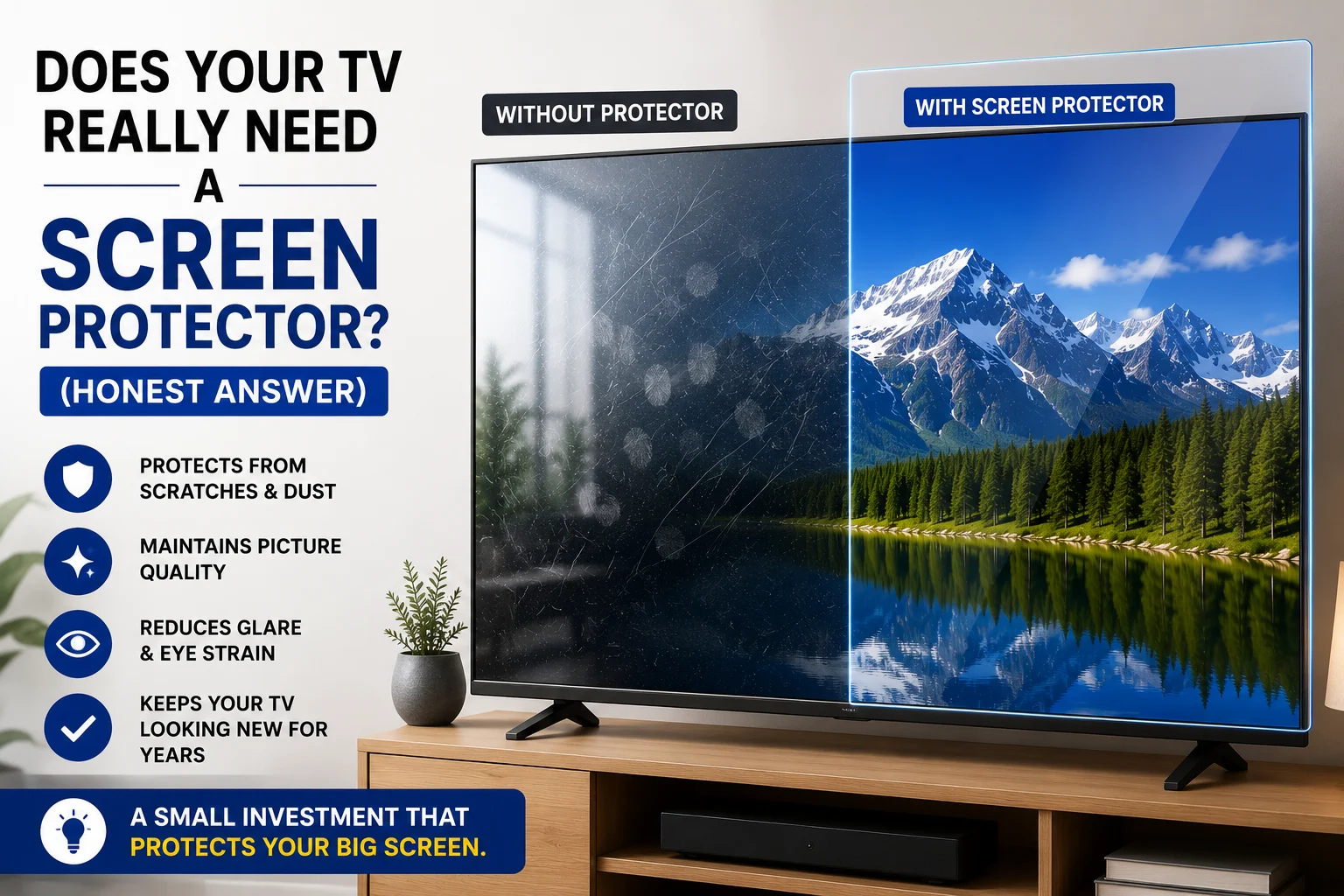
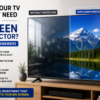
Does Your TV Really Need a Screen Protector? (Honest Answer)
Short answer: it depends on your home.
Longer answer: most Indian homes — yes. A few specific setups — no. And the reason most people get this wrong is that they are asking the wrong question.
The question is not “does my TV need a screen protector?” The real question is: what would it cost me if my TV screen got scratched, and how likely is that to happen?
Once you answer that honestly, the decision makes itself.
The Case For Skipping It
Let us be fair. There are situations where a TV screen protector is genuinely unnecessary.
If your TV is wall-mounted at height in a room no children or pets enter. A 65 inch TV mounted 5 feet up in a dedicated home theatre with controlled access faces almost no daily threat. The main risk — cleaning — can be managed with a proper microfibre cloth and careful technique.
If you never wipe your TV screen. Dry wiping is actually the most common cause of screen damage. If you leave dust alone and never touch the panel surface, your risk drops significantly.
If you are comfortable with the replacement cost. Some people are. If your TV is an older 32 inch model in a spare bedroom and replacing it in two years is no concern, a screen protector is a lower priority.
If any of these describe your situation honestly — you may not need one.
The Case For Getting One
For most Indian homes, the honest case looks like this.
Your TV is in a room with children
This is the single biggest risk factor. Children touch TV screens. They point at characters. They press their faces against the panel. They throw things. A 43 inch TV in a family living room or a 32 inch TV in a child’s bedroom faces daily physical contact that an adult-only household simply does not.
The surface coating on modern LED, OLED, and QLED panels is not designed to withstand direct contact. It is designed to be looked at. One enthusiastic fingernail drag from a four-year-old can leave a mark that no cleaning will remove.
You have pets
Cats jump. Dogs wag tails at exactly screen height. A large dog brushing past a floor-standing TV can leave scratches across the panel from its claws or collar hardware. This is more common than most people realise — and the damage is permanent.
You clean your TV screen regularly
This is the one most people do not expect.
The most common cause of long-term TV screen damage in India is not drops, impacts, or children. It is repeated dry wiping with the wrong cloth — or with the right cloth but with dust particles already on the surface.
When you wipe a TV screen with dust present on the panel, those dust particles act as micro-abrasives. Each wipe drags them across the anti-reflective coating. You cannot see the damage after one wipe. After fifty wipes over six months, your picture starts to look duller, hazier, slightly less sharp — and you cannot identify when or why it happened.
A screen protector takes this risk off the table completely. You wipe the protector. The panel beneath is untouched.
Your TV cost more than ₹40,000
This is simply about risk management. A 55 inch Sony Bravia X80 costs ₹65,000. Panel replacement if the anti-reflective coating is scratched starts at ₹18,000 — and some panel replacements cost more than the TV did on sale.
A screen protector for the same TV costs ₹1,199.
The maths are not complicated. Spending ₹1,199 to protect an ₹65,000 investment is not a luxury purchase. It is the same logic as insuring a car — except the premium is a one-time payment and it lasts 2–3 years.
Your TV is in a bright room
This one is not about scratch protection — it is about picture quality right now, today.
If your 55 inch TV faces a window, sits under bright overhead tube lights, or you watch in the afternoon with sunlight in the room, glare is reducing your picture quality every time you watch during the day. An anti-glare screen protector reduces surface reflections by up to 90% and makes daytime viewing on a large TV dramatically more comfortable — without touching picture accuracy at night.
Use up and down arrow keys to resize the meta box pane.
For many Indian living rooms with south or west-facing windows, this alone is worth the purchase.
What Does a TV Screen Protector Actually Protect Against?
Let us be specific, because “protection” is vague and vague claims are how bad products get sold.
Use up and down arrow keys to resize the meta box pane.
Use up and down arrow keys to resize the meta box pane.
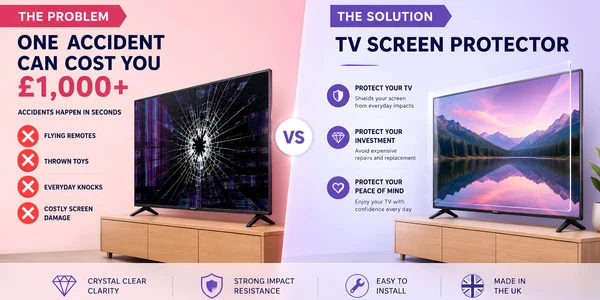
A quality TV screen protector — specifically a 3H-rated nano-film with static cling installation — protects against:
Use up and down arrow keys to resize the meta box pane.
Surface scratches. The 3H-rated film surface absorbs contact from cleaning cloths, fingernails, and minor accidental contact before it reaches the panel coating.
Cleaning damage. Dust drag during wiping — the most common real-world damage mechanism — is redirected to the protector surface, which can be wiped safely and replaced if it gets too scratched.
Fingerprints and smudges. The oleophobic coating on quality protectors means fingerprints wipe off with a single dry cloth pass. On an unprotected panel, fingerprint oils can be harder to remove without risk.
Blue light exposure. Standard protectors reduce blue light by 30%. Blue light filter variants reduce it by up to 50% — meaningful for children watching daily and for adults watching before sleep.
Glare. Anti-glare matte variants reduce surface reflections by up to 90% — the difference between watching a mirror in the afternoon and watching a TV.
What a screen protector does not protect against:
- Hard impacts that crack the panel itself
- Internal damage from drops or electrical faults
- Burn-in on OLED panels from static images
If someone throws something hard at your TV screen, a nano-film protector will not save it. That is not what it is designed for. It is designed for the slow, invisible, cumulative damage that most TVs suffer from — and that most people only notice when it is too late to reverse.
The Honest Answer for Different TV Types
LED and 4K LED TVs (Samsung Crystal 4K, LG UHD, TCL P-series)
Yes, get a screen protector. The anti-reflective coating on LED panels is the primary thing worth protecting. It is not replaceable without full panel replacement.
QLED and Neo QLED TVs (Samsung QLED, TCL QLED)
Yes, especially. Samsung’s QLED anti-reflective coating is specifically vulnerable to cleaning cloth abrasion. QLED panel replacement costs are among the highest in the market.
OLED TVs (LG C-series, Sony Bravia OLED, VU Masterpiece)
Yes, without question. OLED panels have no backlight diffuser layer between the pixel and the surface — the panel coating is the most exposed surface of any TV type. LG OLED panel replacements start at ₹28,000 for a 55 inch. A screen protector for the same TV is ₹1,199.
Budget TVs (Mi TV, Hisense, VU standard range)
Yes, but for a different reason. Budget TV buyers are more likely to be in high-usage family rooms, more likely to replace the TV in 3–5 years rather than repair it, and more likely to have children at home. Protection cost as a percentage of TV cost is higher — but the daily-use risk is also higher.
Tempered Glass vs Nano-Film — What Is the Right Format for TVs?
A lot of people searching for TV screen protectors have the mental model of a smartphone screen protector — a rigid tempered glass sheet. That model does not apply to TVs.
Tempered glass at 55 inches is:
- Extremely fragile to ship — arrives cracked in a significant percentage of orders
- Prone to edge cracking during installation
- Heavy enough to stress the TV’s bezel and stand at large sizes
- Impossible to re-apply if misaligned during installation
The correct format for TV screen protection is flexible nano-film — the same material used in commercial display protection and laptop screen protectors. It is thin, light, flexible, and applies via static cling with no adhesive. If you misalign during installation, you lift it and try again. If it gets too scratched after 2–3 years, you peel it off and replace it.
If you see a seller offering rigid tempered glass for 55 inch or larger TVs — approach with caution.
So — Do You Need One?
Run through this honestly:
| Situation | Recommendation |
|---|---|
| Children in the home | Yes — get one now |
| Pets in the home | Yes |
| TV costs more than ₹40,000 | Yes |
| You clean the screen regularly | Yes |
| Bright room with windows or overhead lights | Yes — anti-glare variant |
| Children watching daily | Yes — blue light filter variant |
| TV wall-mounted, no children, no pets, rarely cleaned | Optional |
| Old TV you plan to replace in 1 year | Optional |
If you ticked even one “Yes” — the decision is already made. A screen protector costs less than a restaurant dinner and lasts 2–3 years.
Which Screen Protector Should You Get?
For most 55 inch TVs in Indian family homes — Screen Guardian’s 55 inch crystal clear protector is the right starting point. 99.5% transparency, 3H scratch protection, static cling installation, 6-month warranty.
If your room is bright or your TV faces a window — the anti-glare variant is worth the small upgrade. 90% reflection reduction makes a visible difference to daytime viewing.
If you have children watching daily — the blue light filter variant reduces blue light by 50% with crystal clear transparency. Recommended for children’s rooms and bedroom TVs watched before sleep.
Not sure which size fits your TV? Read our TV sizing guide — it takes 2 minutes and saves you an incorrect order.
The Bottom Line
Your TV does not technically need a screen protector the way it needs a power cable.
But if children, pets, cleaning, glare, or a replacement cost above ₹18,000 are part of your reality — and for most Indian households, at least two of those are — then a screen protector is the most cost-effective protective purchase you can make for a TV.
It costs less than ₹1,500. It installs in 10 minutes. It lasts 2–3 years. And the thing it protects costs between ₹30,000 and ₹1,50,000.
The honest answer is: yes, you probably need one.
Shop TV Screen Protectors by Size →
Related reading: Best 55 Inch TV Screen Protector in India 2026 · How to Measure Your TV for the Right Screen Protector Size

One thought on “Does Your TV Really Need a Screen Protector? (Honest Answer)”
Pingback: Is It Good to Use a TV Cover? When It Helps and When It Harms