
How to Protect Your TV From Sunlight — Indian Home Guide (2026)
Sunlight and televisions do not get along.
In Indian homes — particularly apartments with south or west-facing living rooms — afternoon sunlight turns an expensive TV into an unwatchable mirror. And beyond the immediate viewing experience, prolonged direct sunlight exposure causes real, permanent damage to TV panels over time.
This guide covers both problems — how to protect your TV panel from sunlight damage, and how to reduce the glare that makes afternoon viewing impossible in bright Indian rooms.
Two Different Problems — One Guide
When Indian TV owners search “how to protect TV from sunlight” they are usually dealing with one of two situations — or both simultaneously.
Problem 1 — Glare during viewing Afternoon sunlight reflecting off the TV screen creates a mirror-like glare that washes out the picture entirely. This happens when a window faces the TV or sits beside the viewing area. The TV is perfectly functional — the sunlight is simply overwhelming it visually.
Problem 2 — Panel damage from direct sun exposure Direct sunlight on a TV panel for hours every day causes real physical damage — UV-related coating degradation, heat-related panel stress, and accelerated wear of the anti-reflective coating. This damage is invisible in the short term but becomes visible as colour shift, uneven brightness, or coating degradation after 12–18 months of exposure.
Both problems are solvable. This guide addresses each separately.
Problem 1 — Glare: How to Make Your TV Watchable in a Bright Room
Solution 1 — Anti-Glare TV Screen Protector (most effective)
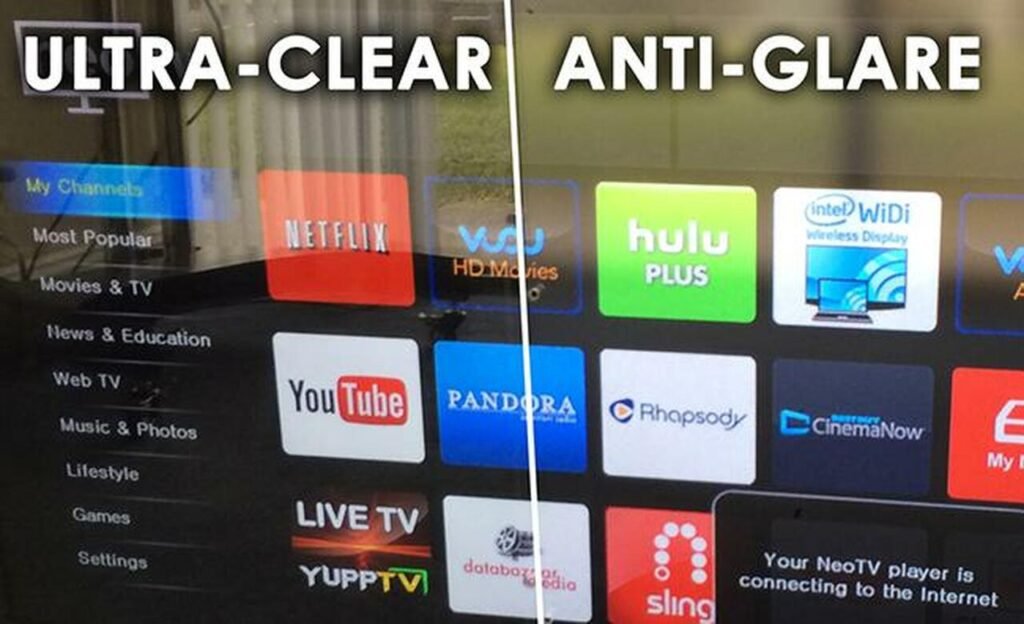
An anti-glare TV screen protector is the single most effective solution for TV glare in a bright Indian room. It sits directly on the TV panel surface and uses a micro-textured optical coating to diffuse incoming light before it reflects back to your eyes.
What it does:
- Reduces surface reflections by 90%
- Eliminates the mirror effect from windows and overhead lights
- Works permanently — not a setting you toggle, not a curtain you draw
The result in a bright Indian living room: A west-facing window pouring afternoon light into the room — which normally makes a 55 inch TV completely unwatchable between 2pm and 6pm — becomes a non-issue. The TV’s own picture is the only thing visible. No mirror. No washed-out picture. No squinting.
Screen Guardian’s anti-glare matte protector reduces surface reflections by 90% at 95% optical transparency — picture quality is preserved at normal 6+ feet viewing distances while eliminating the glare that makes bright-room TV viewing miserable.
Screen Guardian Anti-Glare 55 Inch TV Screen Protector → — ₹2,999
Available for all standard sizes:
Solution 2 — Curtains and Blinds (free but inconvenient)
Blocking the light source before it reaches the TV is the most obvious solution — and the most inconvenient.
What works:
- Blackout curtains on windows facing the TV — effective but you lose natural light entirely
- Venetian or roller blinds angled to block direct sunlight while allowing ambient light
- Sheer white curtains that diffuse direct sunlight into soft ambient light
The limitation: Curtains require you to draw them every time you watch in the afternoon. In Indian summers with afternoon temperatures above 35°C, closed curtains also trap heat — making the room uncomfortable. Blackout curtains that block sunlight also block the cross-ventilation that ceiling fans rely on.
An anti-glare screen protector is more practical — it works without any action from you, in any lighting condition, permanently.
Solution 3 — TV Positioning and Angle
If you have flexibility in where your TV is placed or mounted, positioning makes a significant difference.
Best TV positions relative to windows:
Side wall — perpendicular to windows. The TV faces a wall that is perpendicular to the window. Light enters from the side rather than hitting the TV directly. This is the best natural position — no direct reflection into the viewer’s eyes.
Opposite wall — facing away from the window. The TV is on the wall opposite the window. Light comes from behind the viewer toward the TV. This creates less glare than light hitting the TV from the side but is still reflective on glossy panels.
Worst position — same wall as the window. The TV and window are on the same wall. The viewer sits with their back to the TV and faces the window — or the window light hits the TV directly. This is the most common problematic layout in Indian apartments.
If you cannot change the TV position: A tilting wall mount allows you to angle the TV slightly — even 5–10 degrees can redirect a direct window reflection away from the primary viewing angle.
Solution 4 — TV Backlight (reduces perceived glare)
A TV backlight — an LED strip mounted behind the TV on the wall — reduces the perceived contrast between the bright room and the TV screen. This does not reduce actual glare but makes the TV picture appear more vivid by reducing the eye’s adaptation to ambient brightness.
Govee TV backlight strips are popular in India and available on Amazon for ₹1,500–₹3,000. They are not a substitute for an anti-glare protector in a very bright room but are a useful addition in moderately bright rooms.
Problem 2 — Panel Damage: How to Protect Your TV From Sun Exposure
Does Sunlight Actually Damage TV Panels?
Yes — but the timeline and mechanism depend on the type of exposure.
Direct sunlight on the screen surface: UV radiation in direct sunlight degrades the anti-reflective coating on TV panels over time. The coating — which gives LED, QLED, and OLED panels their visual clarity and glare reduction — is applied in thin optical layers that UV radiation breaks down gradually. After 12–24 months of regular direct sun exposure, the coating develops uneven areas that appear as milky or discoloured patches.
Heat from direct sun exposure: OLED panels are particularly sensitive to heat stress. The organic compounds in OLED pixels degrade faster at elevated temperatures. A 65 inch LG OLED in direct afternoon sunlight can reach surface temperatures that accelerate OLED pixel burn-in and compound degradation. LG’s own guidelines recommend keeping OLED TVs away from direct sunlight.
Thermal cycling — expansion and contraction: Repeated cycles of heating (afternoon sun) and cooling (air conditioning or evening) cause the panel materials to expand and contract. Over months, this thermal cycling can cause delamination — separation of the panel layers — that appears as bubbles or cloudy areas on the screen.
How to Protect Your TV Panel From Sunlight Damage
Step 1 — Reposition the TV if possible The most effective protection is removing the TV from direct sunlight entirely. A TV that never receives direct sun exposure is not at risk from UV damage, heat stress, or thermal cycling. If your current TV position puts it in direct afternoon sun — moving it to a perpendicular wall, or mounting it on a wall that does not receive direct sun — eliminates the risk entirely.
Step 2 — Use a UV-filtering window film Indian homes with south or west-facing windows can benefit from window tinting film — a transparent adhesive film applied to the glass that blocks 99% of UV radiation while allowing visible light through. Available from ₹500–₹1,500 per metre from hardware stores and online. This protects the TV, the furniture, and everyone in the room from UV exposure simultaneously.
Step 3 — Apply a screen protector Screen Guardian’s nano-film protectors add a protective layer over the panel’s anti-reflective coating. While the primary function is scratch protection, the film also provides a UV-absorbing barrier that reduces the UV radiation reaching the underlying panel coating. This slows UV-related coating degradation in rooms with significant indirect sun exposure.
Step 4 — Use a TV dust cover when not in use For TVs in rooms with direct sun exposure, a fabric dust cover during daytime hours when the TV is off protects the panel from UV radiation and heat during peak afternoon sun. A simple non-woven fabric cover (₹200–₹500) placed over the TV from 11am to 5pm blocks the UV and heat that cause the most long-term damage.
Step 5 — Enable ambient light detection on your TV Most Samsung, Sony, LG, and TCL smart TVs have an ambient light sensor that automatically reduces screen brightness in bright rooms. This reduces the heat generated by the panel backlight during bright conditions. Enable it in your TV’s picture settings. It will not protect the panel surface from UV but it reduces heat-related stress on the backlight components.
The Indian Home Checklist — Sunlight and TV
| Situation | Best solution |
|---|---|
| TV facing a west-facing window | Anti-glare screen protector + side curtains |
| TV in direct afternoon sunlight | Reposition + UV window film |
| Bright overhead tube lighting causing glare | Anti-glare screen protector |
| LG OLED in a sunny room | Reposition to avoid direct sun + screen protector |
| Samsung QLED with glare issues | Anti-glare screen protector |
| TV unwatchable between 2–6pm | Anti-glare screen protector + angled blind |
| TV in a covered balcony or verandah | UV window film + screen protector |
Anti-Glare vs Crystal Clear — Which for a Sunny Indian Room?
If your room has significant ambient light from windows or overhead tube lighting during your main viewing hours — anti-glare matte is the correct choice without exception.
Crystal clear protectors reduce reflections by 60% — meaningful but not enough for a west-facing window with direct afternoon sun. Anti-glare matte reduces reflections by 90% — the difference is visible and significant in bright Indian conditions.
For rooms where you watch primarily in the evening with controlled lighting — crystal clear is sufficient and delivers 99.5% transparency with no texture.
When in doubt — anti-glare. You can always watch in a dark room with a matte protector. You cannot comfortably watch a glossy screen in a bright Indian afternoon.
Read the full comparison: Anti-Glare vs Crystal Clear TV Screen Protector
Frequently Asked Questions
Can sunlight damage my TV permanently?
Yes. Direct UV radiation degrades TV panel coatings over 12–24 months. Heat stress from direct sun accelerates OLED pixel degradation and can cause panel delamination. The damage is invisible initially but becomes visible as colour shift, milky patches, or coating unevenness. Repositioning the TV and using UV window film prevent this.
Why does my TV look washed out in the afternoon?
Direct or strong indirect sunlight reflecting off the glossy TV panel overwhelms the TV’s picture brightness. This is a glare problem, not a TV problem. An anti-glare screen protector reduces surface reflections by 90% — solving this permanently without curtains or repositioning.
Is the anti-glare screen protector effective for all TV brands?
Yes. Screen Guardian’s anti-glare protector fits all standard 55, 65, 43, 32, and 75 inch panels from Samsung, Sony, LG, TCL, Mi TV, and all other major brands sold in India.
Does an anti-glare protector affect picture quality? At normal TV viewing distances of 6+ feet — no. Transparency is 95% and the matte texture is not visible at standard distances. Colour accuracy, 4K resolution, and HDR performance are preserved. At very close range (under 4 feet) a slight matte texture is visible — at normal Indian TV viewing distances it disappears completely.
Can I reduce TV glare without buying anything? Yes — partially. Tilting the TV mount 5–10 degrees, using venetian blinds angled away from the TV, and enabling ambient light detection on your TV all reduce glare to some degree. None of these are as effective as an anti-glare screen protector, which addresses the root cause at the panel surface.
The Bottom Line
Protecting your TV from sunlight in an Indian home comes down to two things — blocking the light before it reaches the TV, and changing how the TV panel handles the light that does reach it.
Repositioning, curtains, and UV window film address the first. An anti-glare screen protector addresses the second — and does it permanently, without curtains, without changing your room, and without affecting the picture you paid for.
Screen Guardian’s anti-glare matte TV screen protectors are precision-cut for all standard Indian TV sizes, reduce surface reflections by 90%, and ship pan India within 24 hours from ₹2,999.
Shop Anti-Glare TV Screen Protectors →
Related reading: Anti-Glare vs Crystal Clear TV Screen Protector · Does Your TV Really Need a Screen Protector? · What Is an OLED TV Cover? · Scratch on TV Screen — Can It Be Fixed?

One thought on “How to Protect Your TV From Sunlight — Indian Home Guide (2026)”
Pingback: Is It Good to Use a TV Cover? When It Helps and When It Harms